
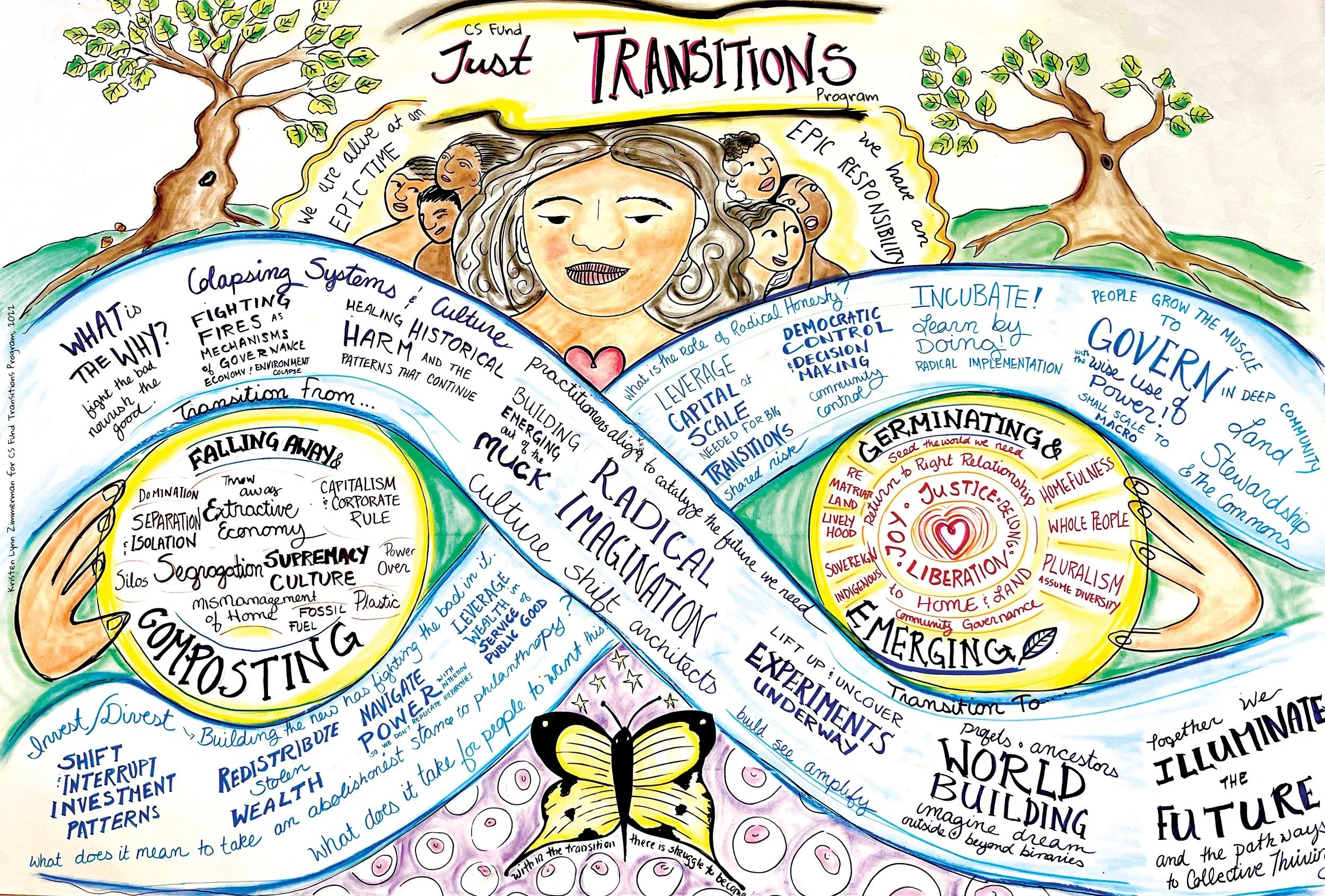
PROGRAM AREA: JUST TRANSITIONS
Building intersectional, community-level social and ecological justice
Our social and ecological communities face compounding global crises and structural injustices, which are all rooted in the same extractive culture driven by white supremacy, patriarchy, imperialism, casteism, anthropocentrism, and other forms of exploitation. BIPOC and other marginalized communities have been facing existential threats for centuries but now these threats are elevated across our entire species and life-supporting ecosystems. As current extractive systems will not be able to continue to support those in power, they will inevitably seek to control the transition of resource industries, which will continue to perpetuate the supremacist culture over our social and ecological communities.
As movement and frontline leaders like Climate Justice Alliance and Movement Generation state, “Transition is inevitable. Justice is not.”

Mission
To build intersectional, community-level social, economic, political and ecological justice at a scale that can shift systemic power from our current extractive, supremacist culture to one of justice, joy, belonging and liberation.
Vision
Under-resourced movements and grassroots coalitions for systems change have critical base-building support
Proven strategies are scaled and new approaches can experiment and grow
Movement spaces are tighter knit, with more common expressions and interlinkages of authentic climate justice and racial justice in different sectors
Movements in different geographies, cultures and countries share broader learning and coalition building to build and shift power
Global North and Global South movements are connected to form a stronger Global Majority
Philanthropic resources for Just Transition aligned work are increased in a way that is trust based and values aligned, and ideally redistributes resources and power
Approach
We seek to bridge, weave and deepen relationships among and across movement geographies and sectors. We prioritize support for grassroots organizations connected to movements and movement organizations accountable to communities.
Objectives
Climate
Build the climate justice movement translocally, transnationally, and globally; use climate as an open table to bridge other social movements.
Intersectional Justice
Build connective tissue across sectors, geographies, cultures, and identities to strengthen collective movements.
Just Transition for Other Sectors
Advance a Just Transition for the Digital Justice and Humanitarian Response sectors; build solidarity between Labor Justice and Ecological Justice.
Priorities
Sectors
All grantees frame their work as both social (racial, gender, and/or caste) and ecological justice, and many work across several sectors:
Climate and Environmental Justice, Food Sovereignty, Native Sovereignty, Black Liberation, Worker Justice, Technology Justice, Healing Justice, Humanitarian and Emergency Response, Public Health, Creative Placemaking and the Arts, Media, and Transformative Justice.
Geographies
Geographies were selected as a result of guidance by movement, frontline and funder partners. We docus on under-resourced areas with pronounced climate/environment risk and geopolitical opportunities:
Mesoamerica and the Caribbean
South Asia
West Africa
United States (Alaska, Hawai’i, the Midwest and Puerto Rico)
Global Networks
Application
Applicants were identified both through an open process and direct outreach to organizations identified through trusted partners. The application process was designed to be as transparent, accessible, and least-extractive of applicants’ labor as possible, featuring trust-based and language justice practices.
Core Grants
85 general support grants of $10,000 to $20,000 were made for a 3-year cycle in 2023.
Community of Praxis
Grant support is complemented by an opt-in cohort.
Co-Govern to Co-Liberate Fund
Each of the five regions govern a democratic grantmaking fund.
75% of grantees are grassroots organizations working in their own communities
60% are outside of the US (not including Alaskan, Hawaiian, and Puerto Rican organizations forcibly identified as working in US states/territories)
70% are women led
50% are Indigenous led
The median annual operating budget is $250,000 for grassroots organizations and $426,000 for all grantees
Co-led by facilitators Rosa González and Alixa García, the Community of Praxis offers a virtual space to build deep relationships and collective power across sectors, cultures, and geographies.
Guided by locally based movement facilitators, each regional fund created their own guidelines and governance cultures, submitted and discussed grant proposals, and approved an initial round of 30 grants totaling $400,000 across the five funds in 2025.
Geography
This program makes grants in Central America and the Caribbean, South Asia, West Africa, the United States (Alaska, Hawai’i, the Midwest and Puerto Rico) and to Global Networks.